65% of customers were leaving.We found out why.
BMW Group Germany · 2025
The BMW Vehicle Configurator was losing customers mid-journey especially on mobile. Analytics showed 65% drop-off before completion. That led to a UX redesign that restructured the experience, removed the login barrier and launched two new features that brought customers back.
My Role
Senior Product Designer
TEAM
1 Lead, 1 Senior, 2 Mid-designers
Timeline
2024 - 2025
Platform
Mobile + Desktop
65% of customers were leaving.We found out why.
BMW Group Germany · 2025
The BMW Vehicle Configurator was losing customers mid-journey especially on mobile. Analytics showed 65% drop-off before completion. That led to a UX redesign that restructured the experience, removed the login barrier and launched two new features that brought customers back.
My Role
Senior Product designer
Team
1 Lead, 1 Senior, 2 Mid-designers
Timeline
2024 - 2025
Platform
Mobile + Desktop
65% of customers were leaving.We found out why.
BMW Group Germany · 2025
The BMW Vehicle Configurator was losing customers mid-journey especially on mobile. Analytics showed 65% drop-off before completion. That led to a UX redesign that restructured the experience, removed the login barrier and launched two new features that brought customers back.
My Role
Senior Product Designer
Team
1 Lead, 1 Senior, 2 Mid-designers
Timeline
2024-2025
Platform
Mobile + Desktop
3 min read
01
The Problem
A Premium Brand
with a painful buying experience.
Customers were arriving at the BMW Vehicle Configurator. Many coming directly from BMW's social media platforms Instagram and Facebook often letting potential customers to leave the website before they finished.
"Users were investing 10–15 minutes building their dream car, then abandoning it. The experience wasn't matching the premium of the product."
02
How We Found The Problem
We let the data
tell us where.
We used analytics tooling to map the exact drop-off points in the configuration journey. The data showed a clear pattern that users weren't leaving randomly. The majority dropped off after interior seat selection roughly halfway through the journey. This pointed to scroll fatigue rather than disinterest in the product. Users who made it that far clearly wanted to buy. The experience was losing them, not the car.
03
Before And After
Same product.
Different experience.
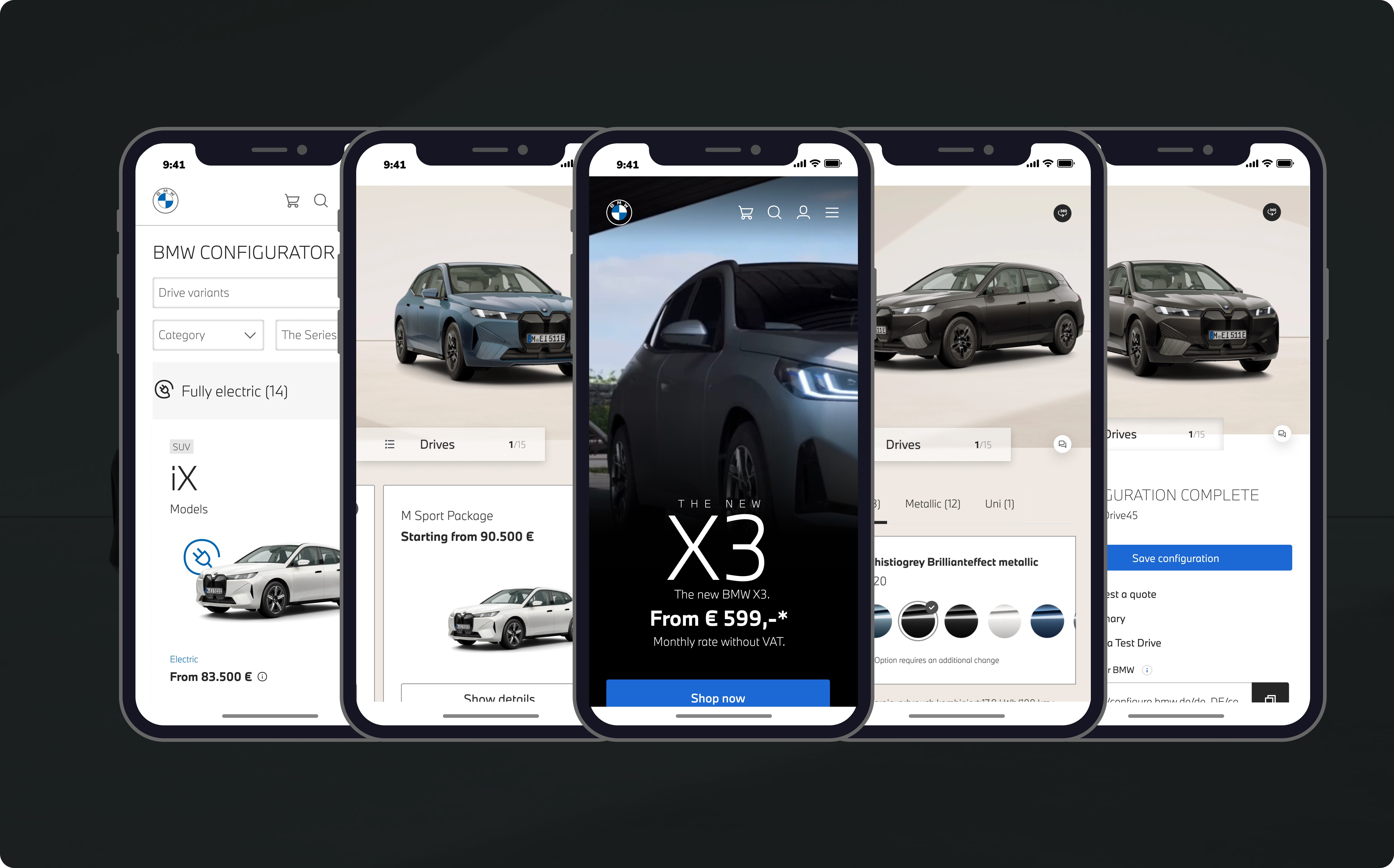
The old configurator treated every option as a list item in an endless scroll. No visual hierarchy, small imagery, dense text and no clear sense of progress through the journey. The redesign made the car the hero and large immersive visualiser, named steps with progress tracking and package cards that let users scan and decide in seconds.
Before - Old Configurator
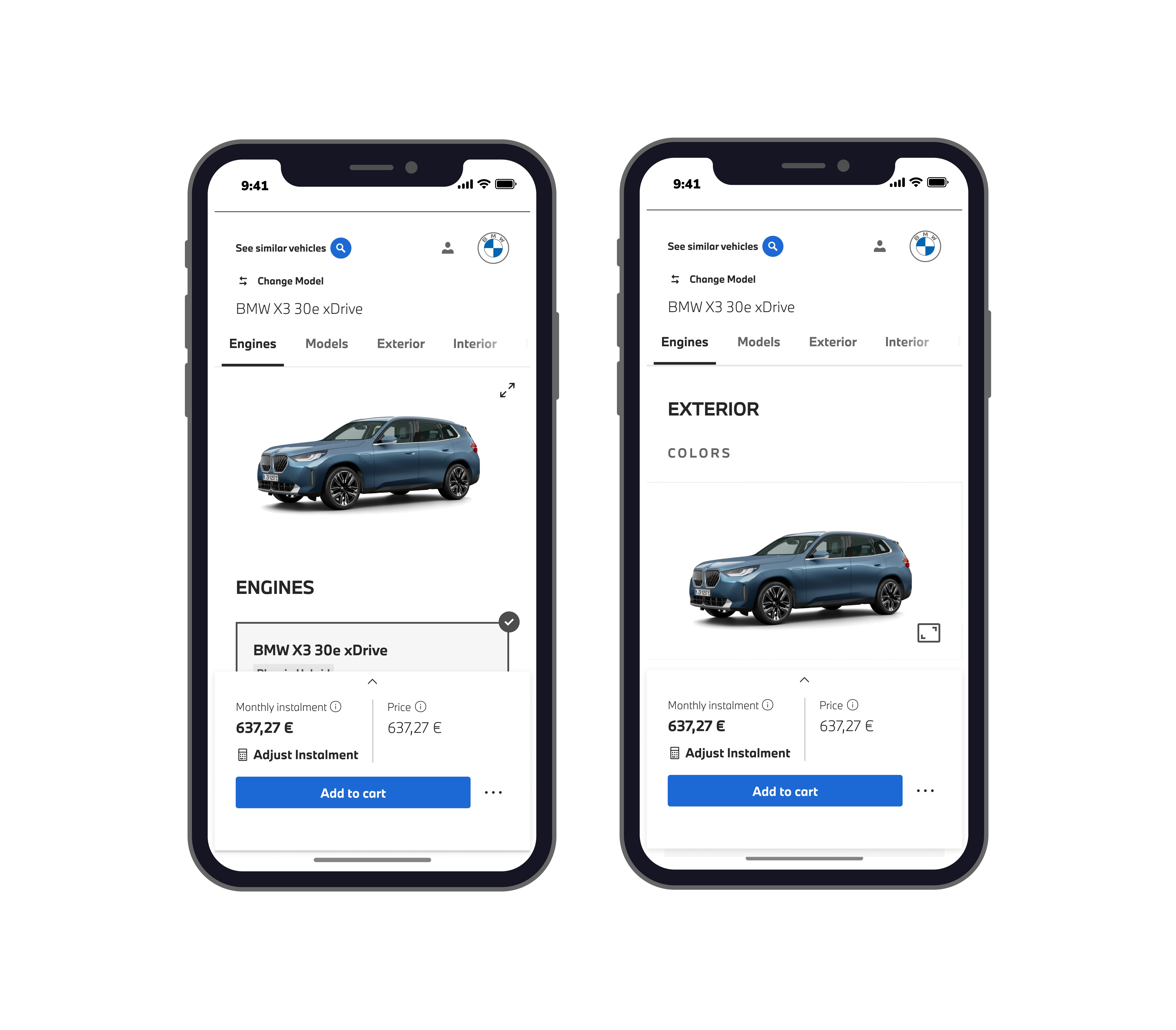
Dense list layout, small imagery, no progress indicator, options buried in scroll
After - Redesigned
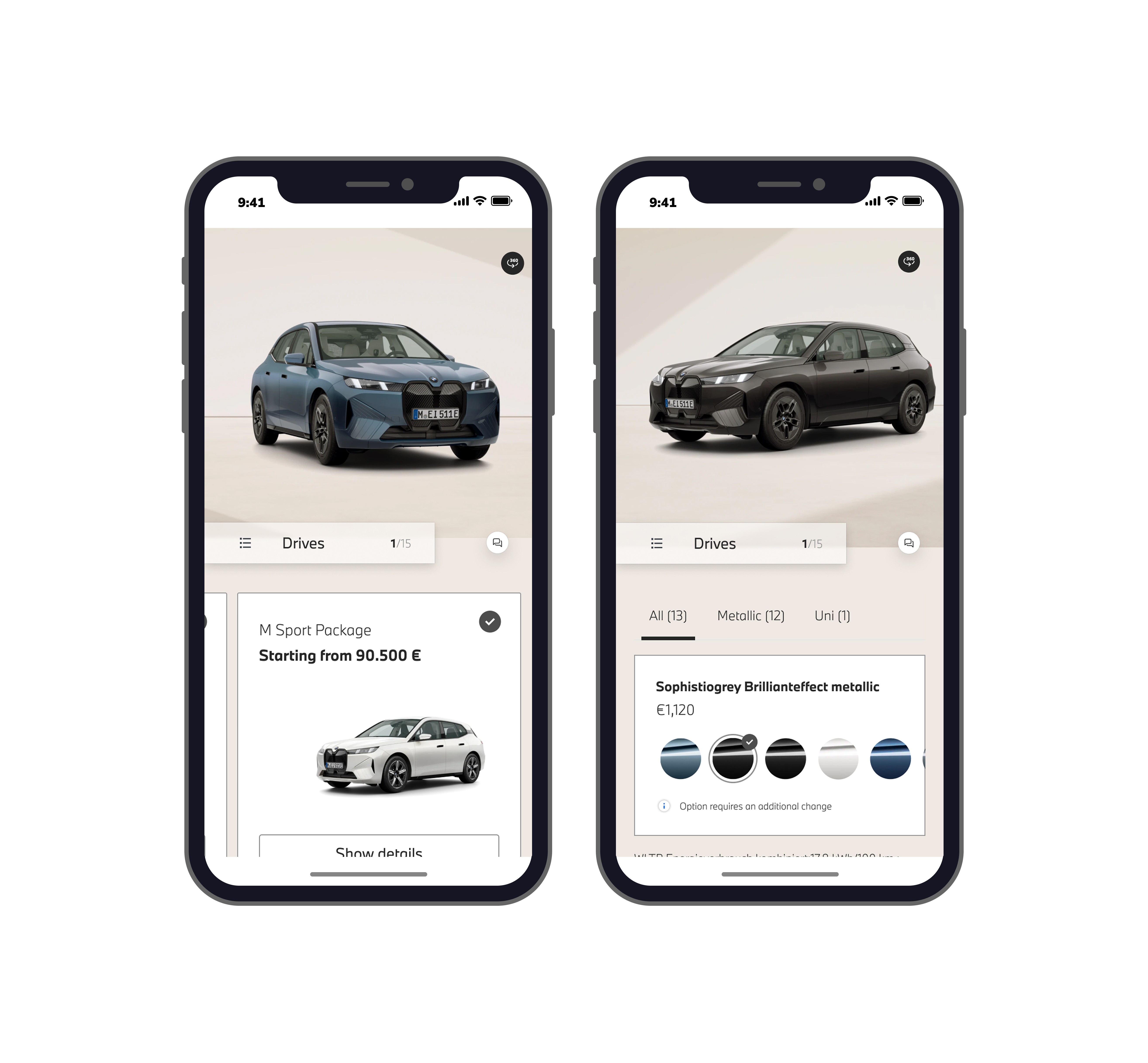
Immersive car visualiser, scannable package cards, step progress (1/15), price always visible
04
Key Decisions
Two decisions that
moved the needle.
Decision One: Replaced infinite scroll with stepped navigation
The old experience was one endless page. We restructured into 15 named steps with clear progress tracking. Users always knew where they were in the journey and how far they had to go eliminating the fatigue that was driving the midpoint drop-off.
Decision Two: Made the car the hero on every screen
In the old design, the car was a small secondary element. In the redesign, a large interactive 360° visualiser anchors every screen updating in real time as users select colours, wheels, and packages. Users could see their car being built as they configured it.
05
Mobile-First Execution
Designed for the thumb.
Built for social traffic.
Because the majority of BMW's configurator traffic arrived from social media on mobile, every decision was pressure tested on a phone screen first. Package cards sized for thumb taps. Price pinned to the bottom bar so it never disappears mid-scroll. Colour swatches enlarged and spaced for finger selection. Step navigation accessible from a fixed bottom control.
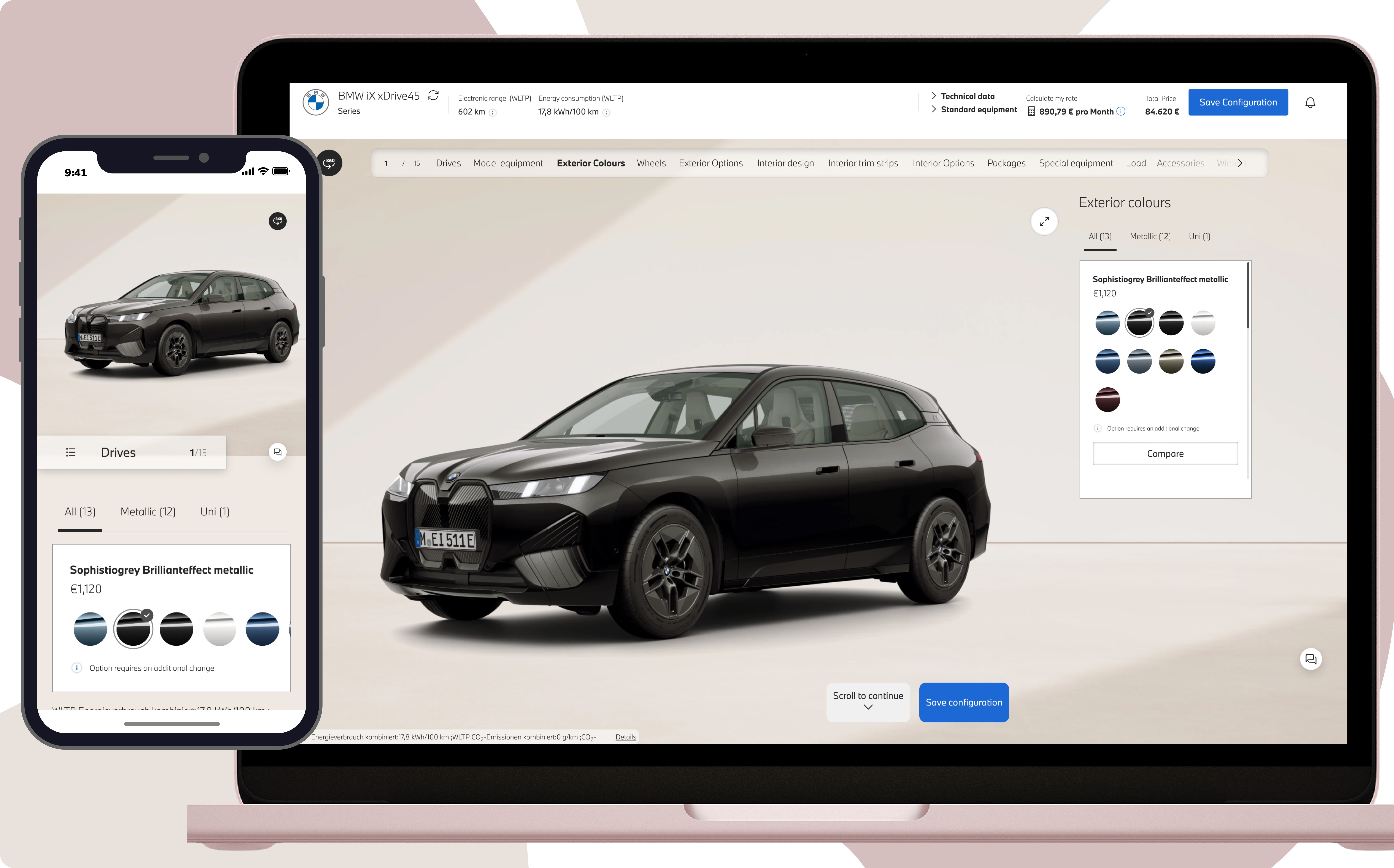
Desktop experience with a large 360° car visualiser occupies the full left panel. Colour selection panel on the right with filter tabs (All, Metallic, Uni), large swatches and price updating in real time in the top bar.
What changed on mobile specifically:
Package cards with car image and price. It is scannable in under 3 seconds instead of reading a text list
Step counter (1/15) always visible. Users know exactly where they are in the journey at all times
360° car view accessible with one tap. Users can inspect their configuration from any angle
No login required to browse stock models or compare making zero barrier for social media arrivals
06
Outcome
From drop-off to
completion.
The redesign addressed every identified drop-off point: scroll fatigue, login friction, mobile usability and lack of visual engagement and launched two new features that removed the barriers stopping social traffic from converting.
65%
Drop-off rate identified and addressed
2
New features launched stock visibility and comparison without login
4
Person team led as a senior designer across 2 mid and 1 junior
07
Reflection
What I took away
The configurator wasn't broken. It was exhausting. The data proved that 65% got halfway through before leaving. The job wasn't to redesign the product from scratch. It was to remove the specific friction points that were turning interest into abandonment.
Next Case Study
Getting 50 managers off excel and using internal tools
Sole designer embedded in an engineering team. Ran user interviews, redesigned the tool from the ground up, and shipped 80% of the redesign despite scope pushback.
b2b
BMW Group
automotive
2024
3 min read
01
The Problem
A Premium Brand
with a painful buying experience.
Customers were arriving at the BMW Vehicle Configurator. Many coming directly from BMW's social media platforms Instagram and Facebook often letting potential customers to leave the website before they finished.
Analytics showed 65% of potential customers dropping off mid-journey, most of them after the interior seat selection step. Dealership contact rates had fallen noticeably, which meant fewer sales conversations and a direct impact on revenue.
The biggest pain point was mobile. Most of BMW's social traffic lands on a phone. The configurator was built for desktop with long scrolling pages, small interactive elements and a login wall that stopped customers cold before they could even contact a sales agent.
"Users were investing 10–15 minutes building their dream car, then abandoning it. The experience wasn't matching the premium of the product."
02
How We Found The Problem
We let the data
tell us where.
We used analytics tooling to map the exact drop-off points in the configuration journey. The data showed a clear pattern that users weren't leaving randomly. The majority dropped off after interior seat selection roughly halfway through the journey. This pointed to scroll fatigue rather than disinterest in the product. Users who made it that far clearly wanted to buy. The experience was losing them, not the car.
01. Scroll fatigue midpoint
Most drop-offs happened after interior seat selection not at the start. Users were engaged but exhausted by the endless scroll before they finished.
02. Login wall before value
Users were asked to create an account or log in before they could save or complete a configuration. On mobile, this killed momentum entirely.
03. Mobile experience unfit for mobile
taffic
The majority of configurator traffic came from social media = mobile users. The experience was built for desktop. Small targets, dense layouts, no thumb-friendly navigation.
03
Before And After
Same product.
Different experience.
The old configurator treated every option as a list item in an endless scroll. No visual hierarchy, small imagery, dense text and no clear sense of progress through the journey. The redesign made the car the hero and large immersive visualiser, named steps with progress tracking and package cards that let users scan and decide in seconds.
Before - Old Configurator
Before - Old Configurator
After - Redesigned
Dense list layout, small imagery, no progress indicator, options buried in scroll
Immersive car visualiser, scannable package cards, step progress (1/15), price always visible
Dense list layout, small imagery, no progress indicator, options buried in scroll
After - Redesigned
Immersive car visualiser, scannable package cards, step progress (1/15), price always visible
04
Key Decisions
Two decisions that
moved the needle.
Decision One: Replaced infinite scroll with stepped navigation
The old experience was one endless page. We restructured into 15 named steps with clear progress tracking. Users always knew where they were in the journey and how far they had to go eliminating the fatigue that was driving the midpoint drop-off.
Decision Two: Made the car the hero on every screen
In the old design, the car was a small secondary element. In the redesign, a large interactive 360° visualiser anchors every screen updating in real time as users select colours, wheels, and packages. Users could see their car being built as they configured it.
05
Mobile-First Execution
Designed for the thumb.
Built for social traffic.
Because the majority of BMW's configurator traffic arrived from social media on mobile, every decision was pressure tested on a phone screen first. Package cards sized for thumb taps. Price pinned to the bottom bar so it never disappears mid-scroll. Colour swatches enlarged and spaced for finger selection. Step navigation accessible from a fixed bottom control.
Because the majority of BMW's configurator traffic arrived from social media on mobile, every decision was pressure tested on a phone screen first. Package cards sized for thumb taps. Price pinned to the bottom bar so it never disappears mid-scroll. Colour swatches enlarged and spaced for finger selection. Step navigation accessible from a fixed bottom control.
Desktop experience with a large 360° car visualiser occupies the full left panel. Colour selection panel on the right with filter tabs (All, Metallic, Uni), large swatches and price updating in real time in the top bar.
What changed on mobile specifically:
Package cards with car image and price. It is scannable in under 3 seconds instead of reading a text list
Step counter (1/15) always visible. Users know exactly where they are in the journey at all times
360° car view accessible with one tap. Users can inspect their configuration from any angle
No login required to browse stock models or compare making zero barrier for social media arrivals
Desktop experience with a large 360° car visualiser occupies the full left panel. Colour selection panel on the right with filter tabs (All, Metallic, Uni), large swatches and price updating in real time in the top bar.
06
Outcome
From drop-off to
completion.
The redesign addressed every identified drop-off point: scroll fatigue, login friction, mobile usability and lack of visual engagement and launched two new features that removed the barriers stopping social traffic from converting.
65%
Drop-off rate identified and addressed
2
New features launched stock visibility and comparison without login
4
Person team led as a senior designer across 2 mid and 1 junior
65%
Drop-off rate identified and addressed
2
New features launched stock visibility and comparison without login
4
Person team led as a senior designer across 2 mid and 1 junior
07
Reflection
What I took away
The configurator wasn't broken. It was exhausting. The data proved that 65% got halfway through before leaving. The job wasn't to redesign the product from scratch. It was to remove the specific friction points that were turning interest into abandonment.
Next Case Study
Getting 50 managers off excel and using internal tools
Sole designer embedded in an engineering team. Ran user interviews, redesigned the tool from the ground up, and shipped 80% of the redesign despite scope pushback.
B2B
BMW Group
automotive
2024
Next Case Study
Getting 50 managers off excel and using internal tools
Sole designer tied in an engineering team. Ran user interviews, redesigned the tool from the ground up, and shipped 80% of the redesign despite scope pushback.
B2B
bmw gROUP
automotive
2024